Analytics platform
WebGod
A SaaS platform for in-depth website audits and monitoring. Health, security, speed and SEO in one place. Clear even to people who aren't technical.

01The brief
Slow loading, technical errors and poor SEO cost businesses real money – the site drops in search results and loses organic traffic. Standard analytics tools do find the problems, but they speak the language of developers. The goal was to build a platform that regularly monitors a website's technical quality and performance and explains in plain terms what is holding its growth back and exactly how to fix it.
02The solution
WebGod consists of three connected parts. I designed and built all of them from scratch through to live production.
Marketing website
I turned the supplied design into a sales and presentation website. Besides the homepage, it includes:
- an overview and pricing of the plans,
- dedicated pages for each tool,
- a knowledge base with how-to guides,
- an FAQ and an introduction to the project,
- complete legal documentation (terms and conditions, privacy policy, cookies).
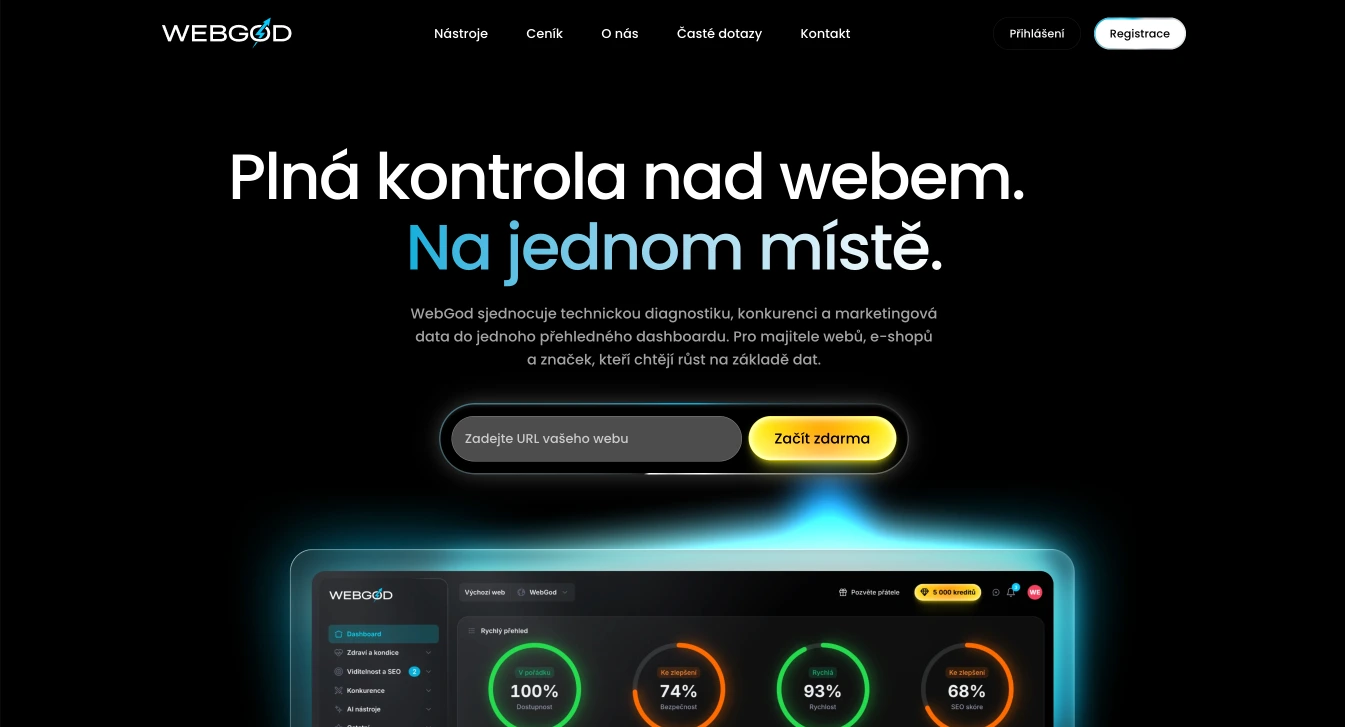
The key element is onboarding. Visitors enter their website address and, before even signing up, get an initial analysis with the issues found and a comparison with competitors. That way they can see the product's value before committing to anything. Signing up then takes just a few seconds via email, Google or Facebook.
Client app
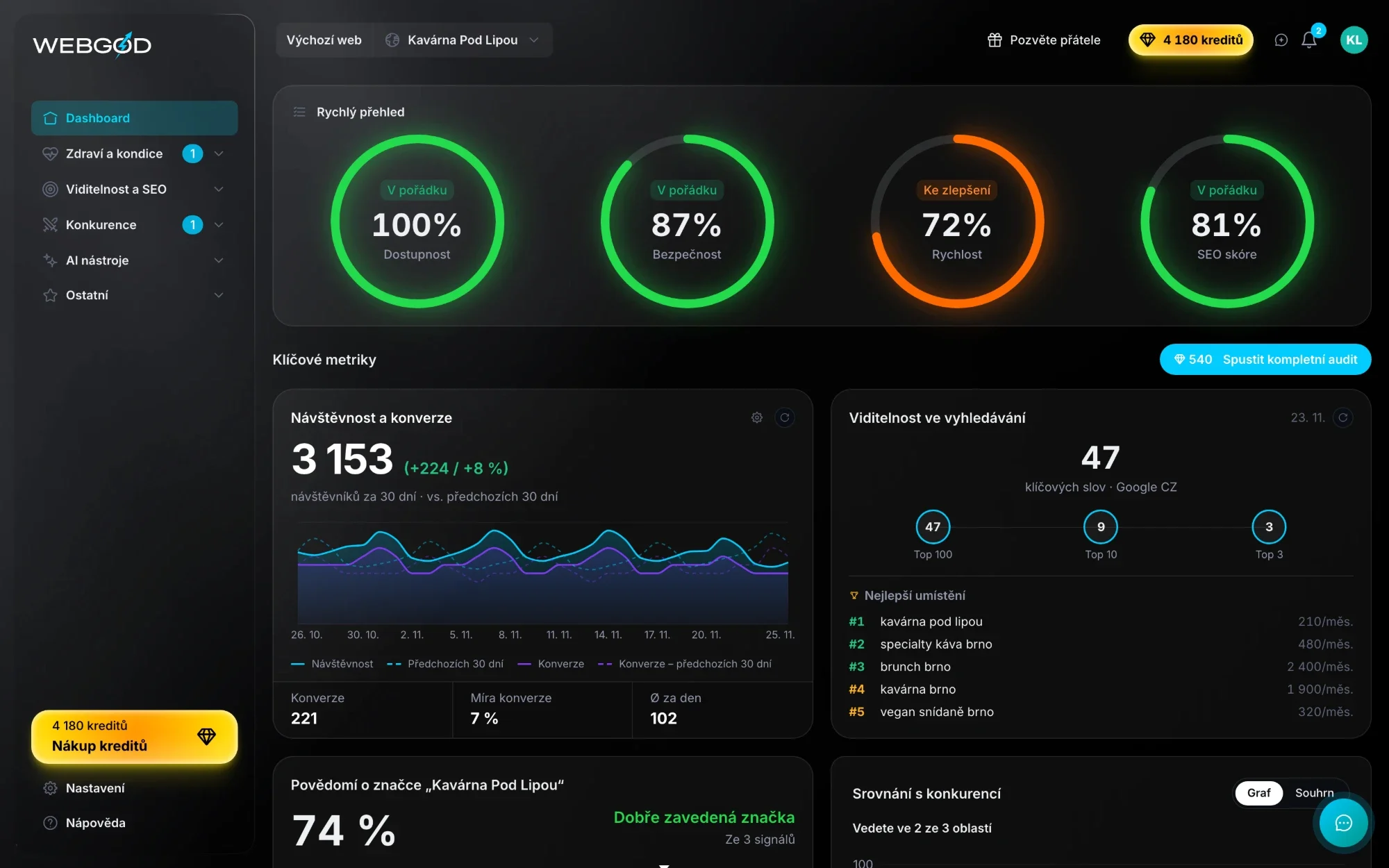
The user's main workspace. Customers add their website and run in-depth checks of:
- security,
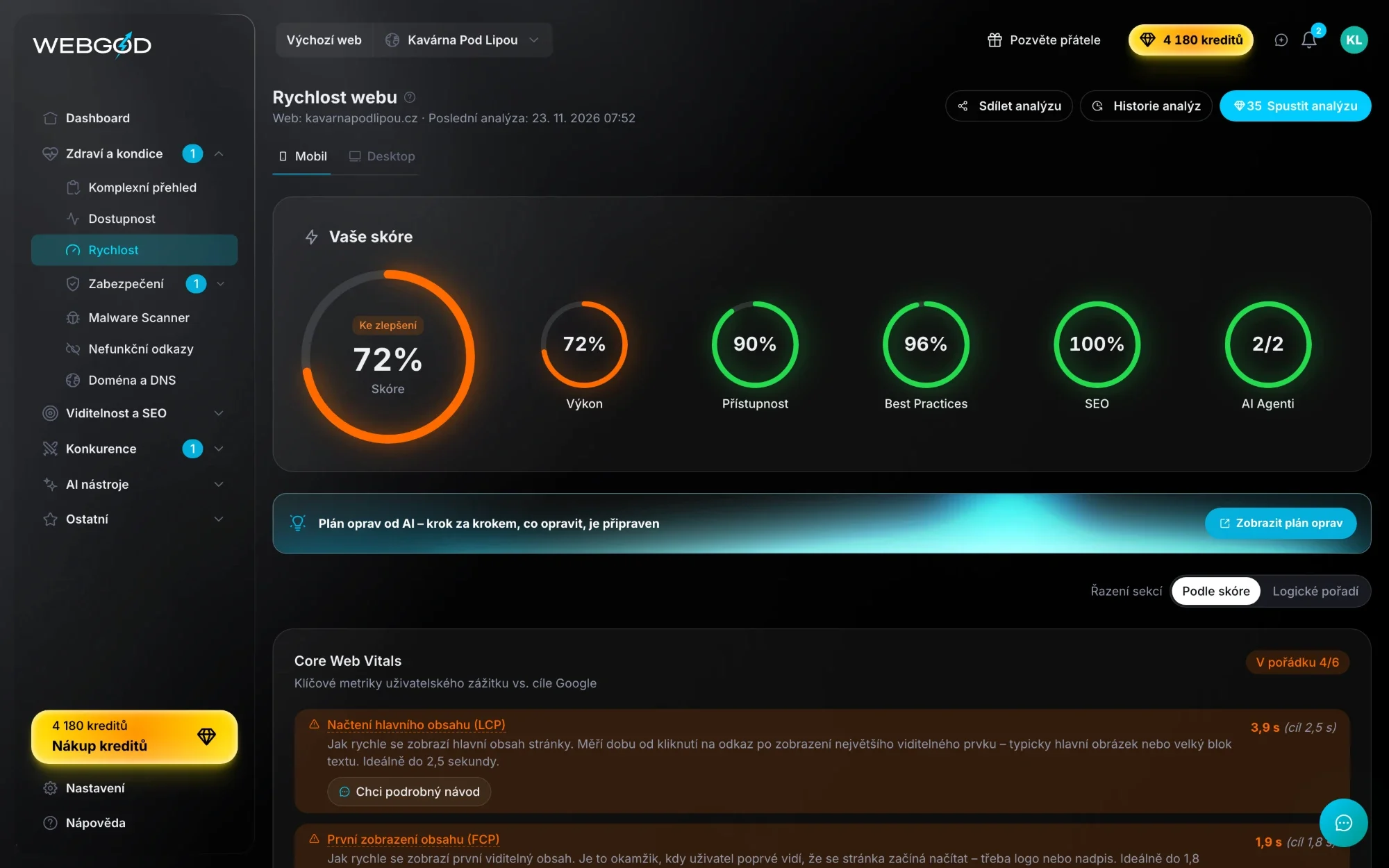
- loading speed,
- technical SEO,
- broken links,
- visibility in AI search engines,
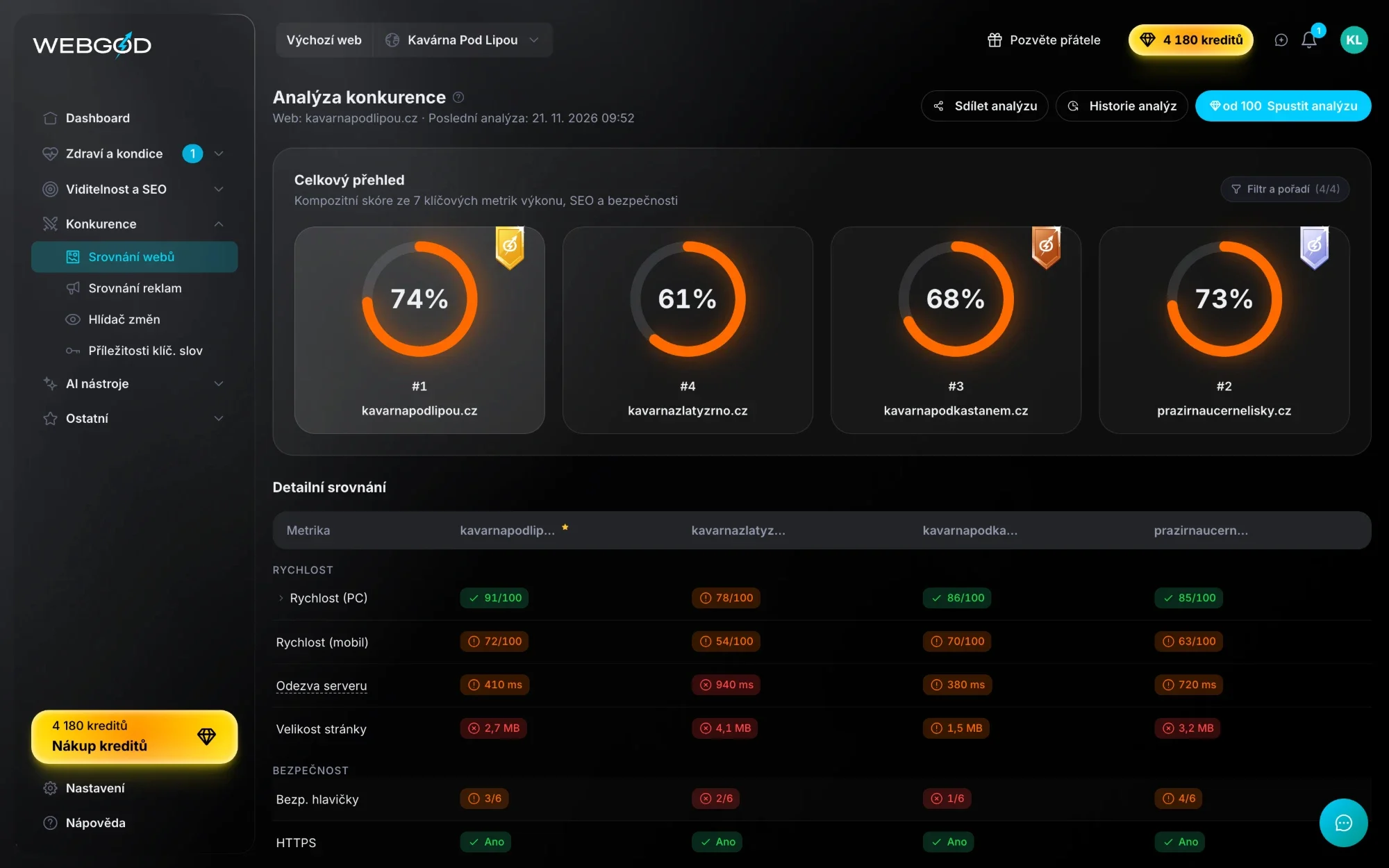
- how it compares with competitors.
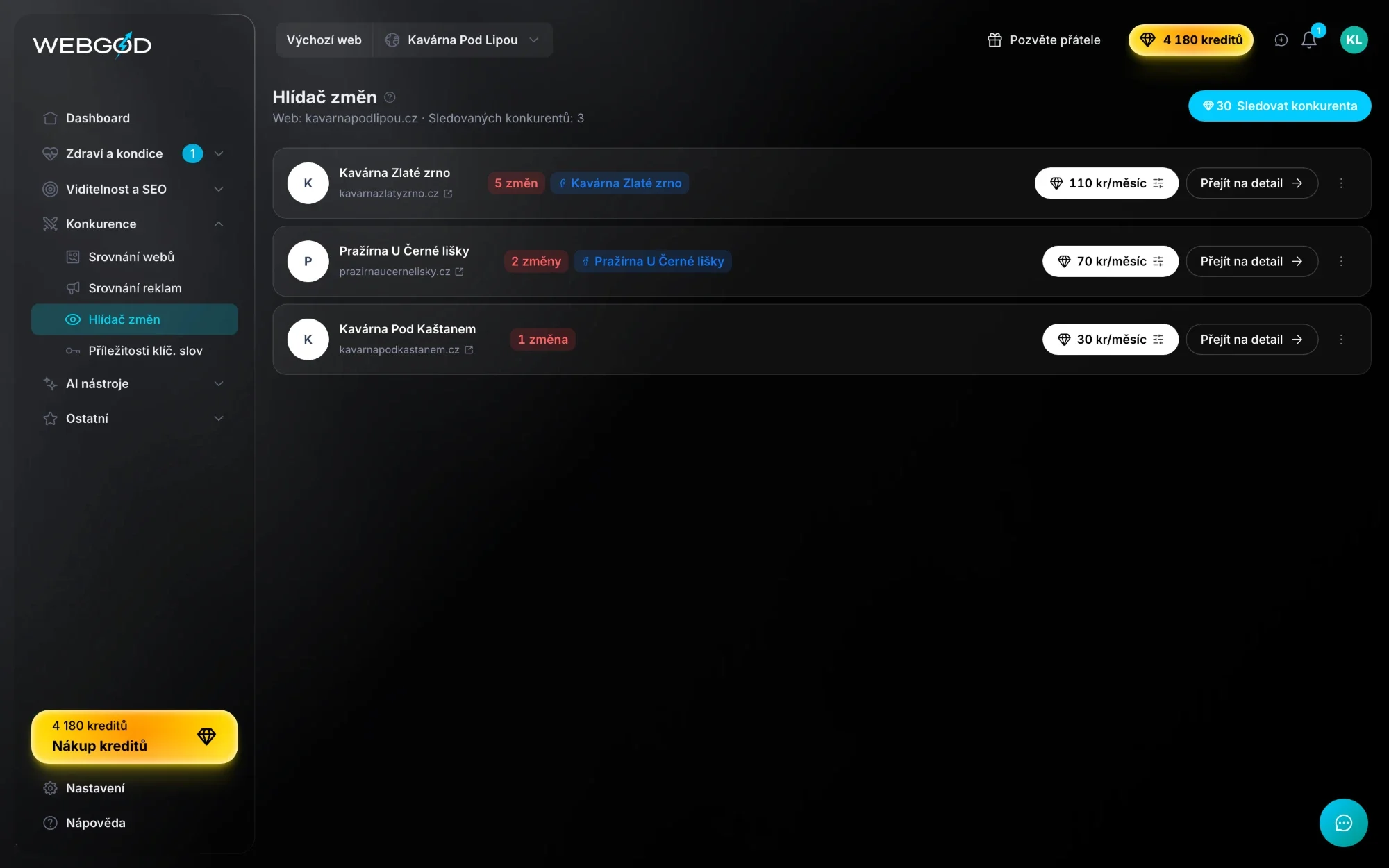
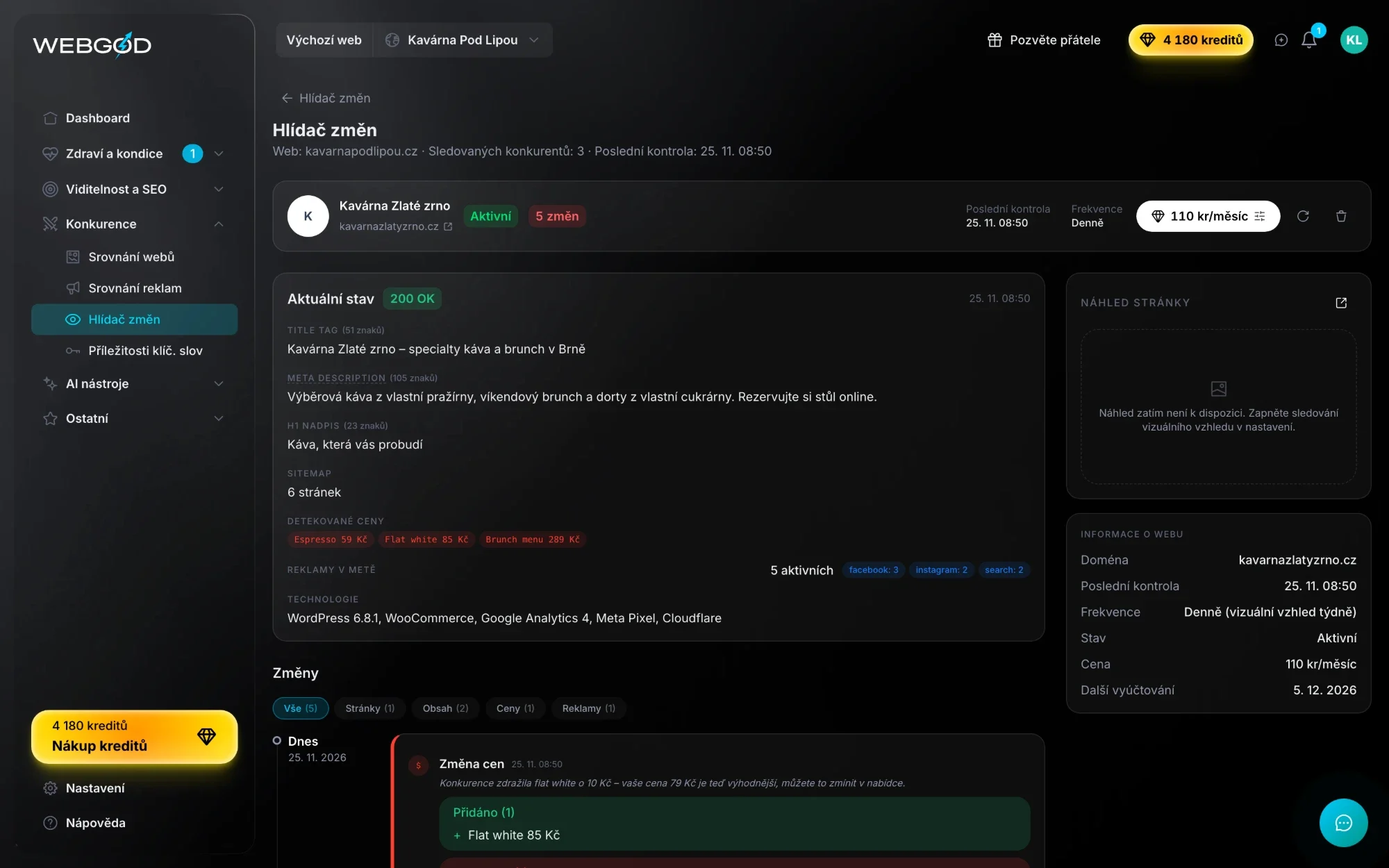
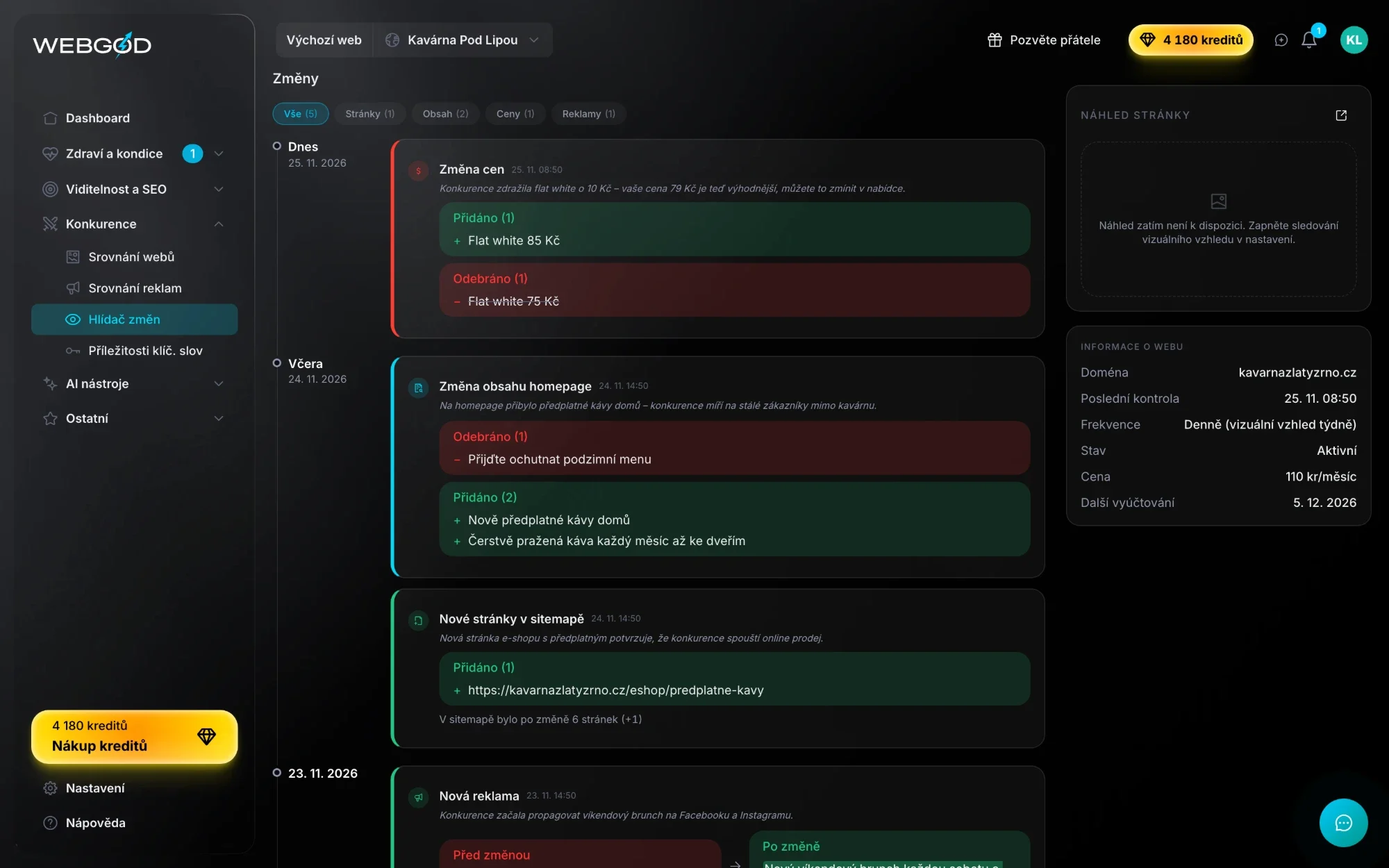
Every audit ends with a clear score, an explanation of the impact and specific instructions for fixing it. The app also monitors the website around the clock. It tracks uptime, changes on competitors' websites and their ad campaigns. Once connected to Google Analytics and Search Console, it shows real traffic and search rankings in one place.
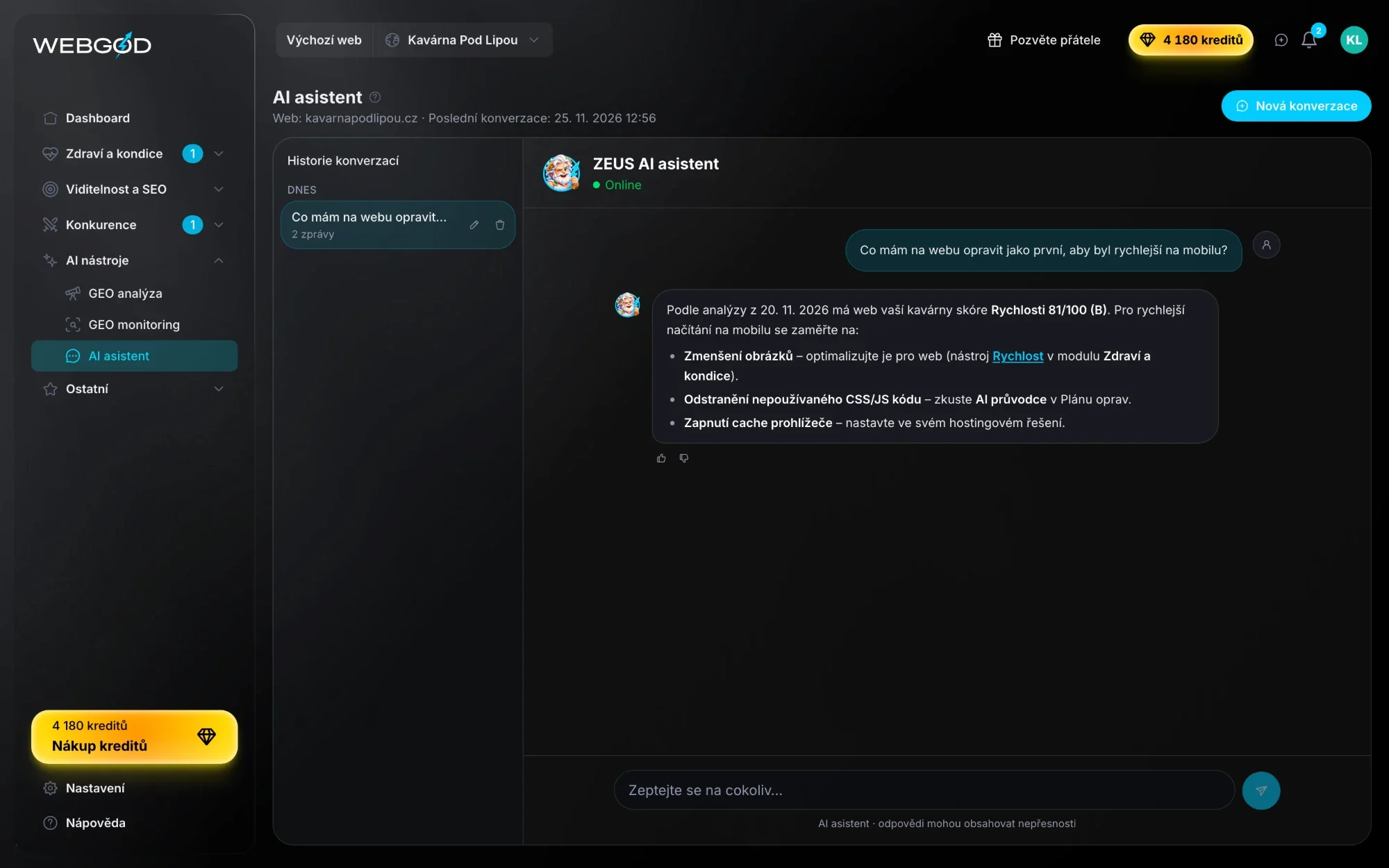
An AI assistant runs on top of all the data and knows the context of each specific website. Users can ask it what to fix first or how to solve a particular technical error. Results can be exported to a PDF report with one click and shared with the team.
Internal CRM
The back office that customers never see. It gives an overview of users, payments, credits and the costs of external services, including automatic alerts for errors and suspicious activity. It also includes customer support tools, such as refunding credits or re-running an analysis after an outage.
The whole product was built with AI vibecoding, from the first prototype to the production version on my own server, which now serves real users.
03How I worked with AI
Vibecoding isn't about writing one prompt and hoping for the best. It's a managed process built on solid architecture, iterative development and continuous testing.
On WebGod, I led a team of specialized AI agents, each with a clearly defined role: development, testing, security, code review, deployment, user interface and product decisions.
The agents check each other's work. Code written by one has to pass tests, a logic review and a security audit before it reaches production. The project rules (API architecture, handling of finances and strict constraints) are firmly documented, so the agents follow them throughout development.
My role was product management and technical oversight. I set the direction and priorities, validated the output and took full responsibility for the final product.
04What I built
- Full development with a team of AI agents
- The marketing website, admin and internal CRM
- External API integrations and analytics data processing
- An AI assistant connected to a vector database
- A credit system and payment gateway
- Security, encryption and server management
- Promo video: A product video made with code and AI (script, motion design in Claude Code, graphics in Claude Design and music in Eleven Labs)
05Challenges and solutions
Protecting user credits
Analyses are paid for with credits, and some take several minutes to run. If credits were deducted up front and the process failed, the user would lose money. So the system reserves credits atomically before starting and automatically returns them on any failure. Even an unexpected crash of the whole server doesn't mean a loss. The app tracks down unfinished transactions on its own and credits them back.
A fallback AI layer and moving data to the EU
The AI provider dropped support for the model behind both the assistant and report generation without warning, which took the entire AI layer offline. I solved it by deploying a fallback chain of models with instant notifications in the admin. I then migrated the whole AI infrastructure to a European provider so customer data never leaves the EU.
Connecting data from audit to action plan
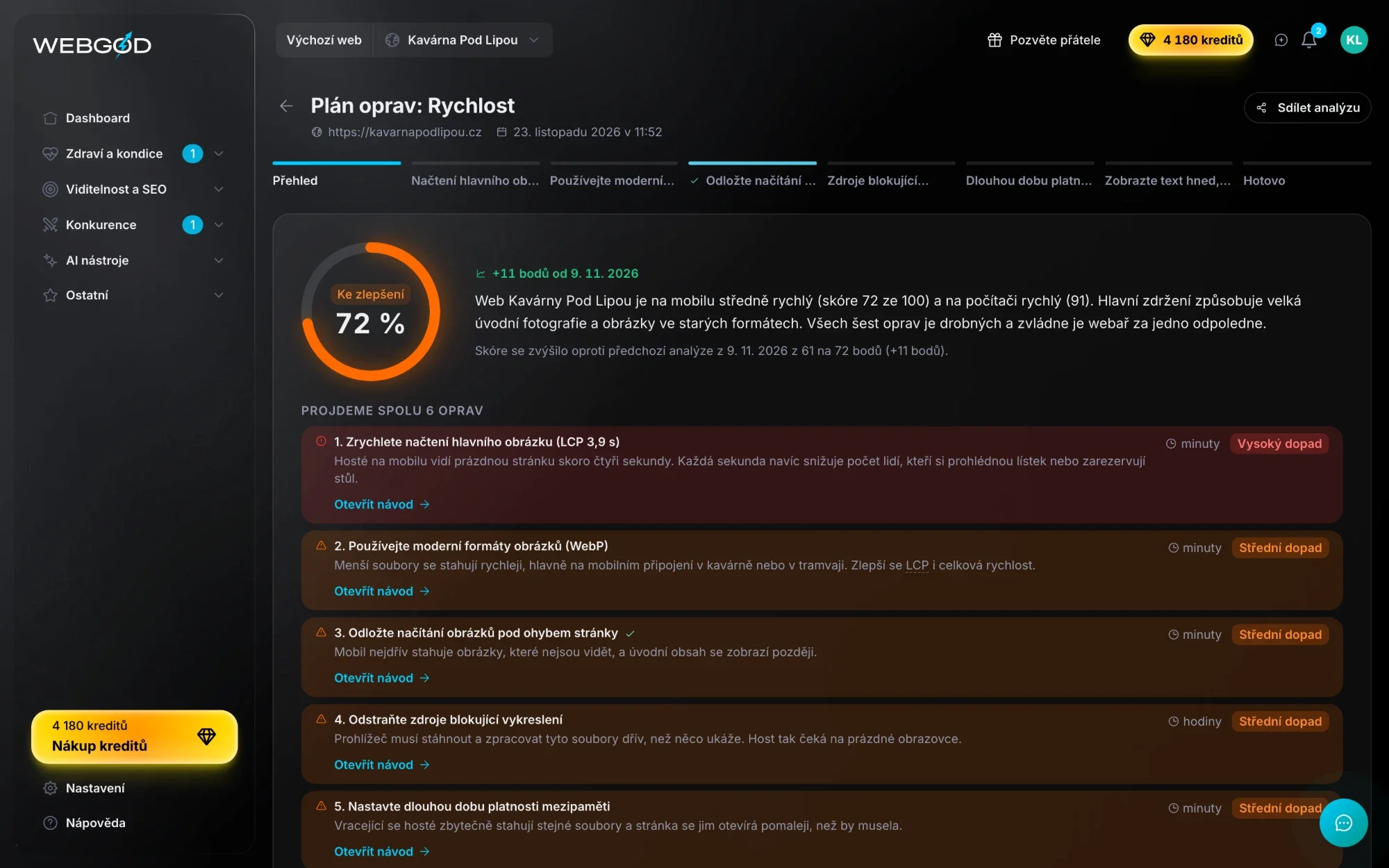
Raw technical data from analyses isn't enough for users. That's why the whole system works as a connected data chain: running an audit generates a structured result, from which the system automatically builds a prioritized fix plan with specific steps and exports a report. All this data is stored in the context of the given website, so the AI assistant can work with it right away, understand how things relate and give precise advice on implementation.
Protecting the AI assistant against manipulation (Prompt Injection)
The AI assistant processes text pulled from third-party websites, where an attacker can hide malicious instructions to override the model's behavior or extract internal data. User queries and external content therefore go through strict sanitization, and system instructions are strictly separated from data. The assistant also has limited, read-only permissions for the context of the specific project, so it can't touch other accounts or affect how the app runs.
Comprehensive security audit and penetration testing
Because the platform handles customer data and a payment gateway and downloads content from third-party websites, basic security wasn't enough. The whole system went through an in-depth security audit and a series of penetration tests. A number of vulnerabilities were fixed, from API security and permission management to protection against SSRF attacks, where an attacker could use a crafted URL to break into the server's internal network. The result is production infrastructure that withstands both common and advanced attack vectors.
06What this approach brings
Team-level output for a fraction of the time and budget
Instead of an expensive team of developers, testers and DevOps specialists, one architect backed by AI agents was enough. There are no delays from communication, approvals or coordination between roles. The product was built for a fraction of the usual cost, at a pace that makes it possible to respond to feedback immediately and ship new features within hours.
A working MVP before you bring in your in-house team
Have an idea for a digital product but don't want to commit expensive development resources right away? I'll build a working version you can use to validate the concept with real users. Meanwhile, your team can stay fully focused on existing projects. Once the product proves itself on the market, they can take over the finished foundation or develop it to their own standards, confident they're building something people actually want.
07Where vibecoding hits its limits
- AI makes different mistakes than people do and needs human oversight: AI can make mistakes that would never occur to a person, and it often wraps them in code that looks perfectly correct at first glance. Automated tests aren't enough. I have to personally review every major step, test it in real-world use and make sure it makes sense from the user's point of view too. Without a final human eye, these blind spots would make it all the way to customers.
- Without technical foundations, you build up technical debt: AI writes a working piece of code on demand, but it doesn't see the bigger picture. Even though I'm not a classic backend developer, my experience with coding and building websites gives me a crucial understanding of how things work under the hood. That lets me keep the project structure in check, understand how the data connects and spot early when AI is heading down a dead end. Without that technical foundation, a fast start would turn into unmaintainable chaos within a few months.
- Responsibility and final decisions always stay with a human: AI carries no legal or business responsibility. Server security, GDPR-compliant data protection and reliable payments need someone who knows the right questions to ask, gets the risks reviewed and makes sure nothing is left to chance. Technology delivers speed, but as a human I have to put in the work for quality and security and vouch for them myself.